- 7030445445



Homebuyers start to evaluate their upcoming borrowing expenses and subsequent monthly payment obligations after the annual Union Budget announcement. People planning to buy a home or refinance an existing loan need to understand government policies, as these rules directly affect the lending rates.
When it comes to the budget impact on home loan, experts look at two things, which include direct policies and broader economic signals that could influence borrowing costs. The Union Budget itself does not set home loan rates. However, it can shape market expectations. Here is how the Union Budget 2026 affects home loan interest rates and EMIs.
Budget 2026 Interest Rates and Lending Environment
The Union Budget 2026-27 explains the government’s financial plans. This includes both the deficit targets and lending strategies. However, it does not directly change home loan rates offered by banks. Lenders decide rates based on RBI policy, their own funding costs, external benchmarks and internal expenses. A clear and stable fiscal plan helps keep inflation expectations steady. It indirectly supports stable interest rates for borrowers.
The RBI’s repo rate is expected to stay steady in 2026. This means sudden changes in home loan rates are unlikely in the near future.
Indirect Budget Effect on EMIs Through Economic Factors
The Union Budget does not cut home loan rates directly. However, it can influence conditions that affect the budget effect on EMIs over time:
- ● Lower inflation pressures could give the RBI room to adjust rates in the future, which will indirectly affect the lending costs.
- ● The way the government manages its finances can have an impact on bond yields, which in turn affects banks’ funding costs and the interest rates they offer on loans.
- ● Investment in infrastructure and housing can improve liquidity in the market, which can enable lenders to provide competitive pricing.
Therefore, home loan rate changes depend on a combination of fiscal expectations, RBI decisions, and bank pricing. It is not dependent on the Budget alone.
Also Read: Rent vs Buy After Budget 2026: What Makes More Financial Sense Now?
Understanding the Relationship Between Budget and Lending Costs
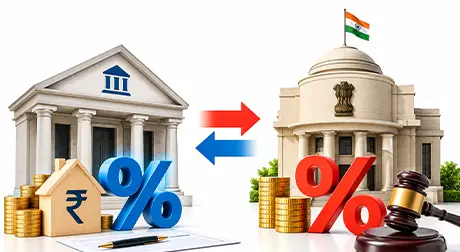
It’s important to know that union budget 2026 housing measures do not instruct banks to reduce home loan rates. Instead, the Budget sets the broader economic context. It can affect market expectations when it comes to inflation and monetary policy. Combined with competition among lenders, these expectations affect the final interest rates offered to borrowers.
Most new loans are linked to benchmarks like the repo rate, so banks adjust floating-rate loans based on these benchmarks. Any change in home loan interest rate will come from market and monetary conditions, not the Budget directly.
Budget Signals and Home Loan EMI Impact
While the Budget does not change monthly payments, it can influence the home loan EMI impact indirectly:
- ● Stable fiscal policy reduces inflation risk, affecting the future RBI decisions.
- ● Government spending on infrastructure may support economic growth and competitive lending.
- ● Existing tax deductions can improve how much borrowers effectively pay for EMIs.
So, while EMIs are not reset by the Budget, it can help create a stable environment that indirectly affects affordability.
Broader Factors That Determine Loan Pricing
- ● RBI repo rate and policy play a major role in determining the banks’ cost of funds.
- ● External Benchmark Lending Rate (EBLR) links floating rates to market benchmarks.
- ● Banks’ costs and liquidity affect the extra charges that are added to the rates.
- ● Borrower risk, credit history, and property details affect the final rate offered.
These factors show why even with stable fiscal policies, EMI changes depend mainly on RBI policies and bank pricing.
How Grihum Housing Assists Home Buyers
Grihum Housing Finance helps homebuyers with loan products that have flexible pricing and tenure options. When homebuyers see the budget impact on home loan affordability, or changes in monetary policies, Grihum helps them plan their repayments, stay updated on the movement of the benchmark interest rate, and choose the right product to help them meet their financial goals.
The company gives guidance on interest rates, down payments, and long-term EMIs. This way, it assists buyers in making informed decisions and adjusting to the changing market conditions.
Also Read: Budget 2026 Highlights for Home Buyers: What Changed and What It Means for You
Conclusion
The Union Budget 2026 sets no specific home loan rate or EMIs. However, it does contribute to the overall economic environment that affects the lending costs. The Budget fiscal stance, combined with RBI policies and competition in banks, sets the environment that determines changes in interest rates.
Understanding this relationship is crucial. However, there is also the aspect of working with companies such as Grihum Housing Finance, which assists borrowers in managing their EMIs and making informed decisions on purchasing homes. Monitoring fiscal policies and credit trends helps buyers make better overall decisions.
FAQs
1. How does Union Budget 2026 impact home loan interest rates?
The Union Budget 2026 does not directly establish home loan interest rates. However, it creates fiscal and economic conditions which will subsequently impact the entire lending environment.
2. Will home loan EMIs increase or decrease after Budget 2026?
EMIs are mainly controlled by the monetary policies and lender pricing. The budget does not directly affect the monthly instalments.
3. Does Budget 2026 make taking a home loan more affordable?
Although it doesn’t affect the interest rates, the fiscal support and tax benefits can be helpful in terms of affordability.
4. How does Budget 2026 affect floating vs fixed home loan rates?
The budget announcements don’t affect the fixed or floating rates. The RBI policies and benchmark settings affect these rates.
5. Is it a good time to take a home loan after Budget 2026?
It could be a good time to take a home loan after Budget 2026 if the economic conditions are stable and the interest rates are favourable, but it should be in line with one’s personal financial situation.